
Trial Account Onboarding
Get started with your new PagerDuty account
Getting started with PagerDuty is straightforward with our trial account setup. Sign up with your work email, choose your personalized web address, and follow our step-by-step onboarding process. Learn how to set up your first service, connect your tools, configure how you want to be notified, and get your team ready to respond to incidents.
Create a Trial Account
- Navigate to our sign up page, enter your Work Email, then click Get Started.
Work Email RequiredNon-work email addresses (gmail.com, yahoo.com, icloud.com, and similar) are restricted and cannot be used to create a trial account.
- Enter your First Name, Last Name, Company, and Country, then click Next Step.
- Enter a Password and click Next Step.
- Enter a Subdomain: PagerDuty accounts are accessible via a personalized subdomain. If your company name is EveryNine Inc., for example, you can set your subdomain to everynine.pagerduty.com, e9inc.pagerduty.com, or any other value that is five or more characters long and is not already in use.
- Select the Service Region where you would like to host your account — USA or EU. Review the Terms of Service and Privacy Policy, check the checkbox to acknowledge and agree, then click Create Account.
Onboarding
The trial onboarding flow helps you get started with your PagerDuty account, from creating your first service to adding the chat tools your team uses to communicate.
Skipped Onboarding?If you skipped the onboarding flow and would like guidance on getting started, refer to the Post-Onboarding resources linked at the end of each section below.
Step 1: Create a Service
A service is an entity you monitor that serves as a container for related incidents. Another way to think of a service is a discrete piece of functionality that is built, run, and owned by a single team.
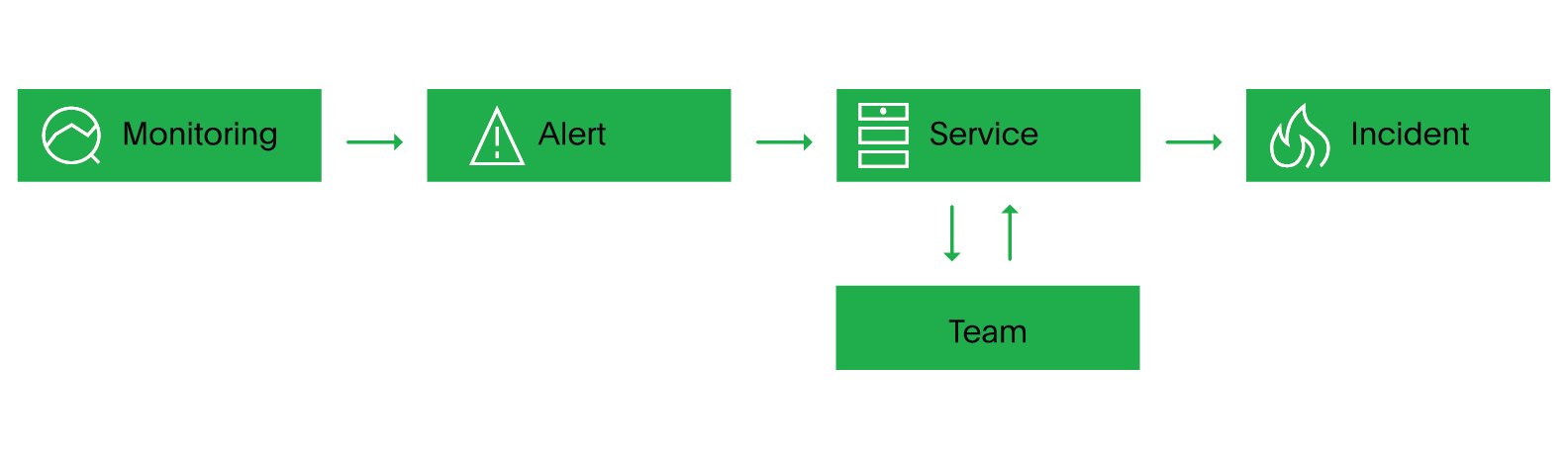
Quickstart flow chart
- Enter a Service Name for a service your team is responsible for. The more descriptive the name, the better. Examples:
- Account Authentication
- Checkout App Server
- Inventory Database
- Click Continue.
Post-Onboarding
- Create a Service: Create more services.
- Configurable Service Settings: Adjust your new service's settings.
Step 2: Configure Inbound Integrations
Your service relies on other tools to receive alerts and data. This information helps you make the right decisions during incident response. Common integrations include monitoring or ITSM tools.
- Select the Integration(s) to add to your service from the Most Popular or All tab. To add integrations later, click Skip step.
- Click Continue.
Post-Onboarding
- Integration Guides: Search for and follow instructions in your integration's guide to complete the integration created during onboarding.
- Add Integrations to an Existing Service: Add more integrations to your service.
- Create a Service: Create a new service with integrations.
Step 3: Configure Notification Methods
When your service experiences an incident, you can be notified via email, voice call, or SMS. During initial account setup, set up all three methods to test them.
Trial Account Notification LimitsTrial accounts have limits on SMS and voice notifications. See the Trial Account Notification Limits section later in this article for details.
- To add phone and SMS notifications, check the Phone & SMS checkbox and enter your phone number. To add email notifications, check the Email checkbox and enter your email address. To configure notification methods later, click Skip step.
- Click Send Test Notification.
- Confirm that your details are correct and click Send Test Notification again. You will receive test notifications via the methods configured.
Post-Onboarding
- Configure Notification Rules: Determine how you are notified during incidents.
- Contact Methods: Add more contact methods.
- User Settings: Manage your user settings.
Step 4: Download the Mobile App
Your services can experience issues at any time. The PagerDuty mobile app lets you acknowledge alerts, run automations, and respond to incidents from anywhere.
- Download the PagerDuty mobile app:


- Click Next to continue.
Post-Onboarding
- PagerDuty Mobile App: Learn more about the mobile app.
Step 5: Configure an On-Call Schedule
On-call schedules map out your team's coverage in PagerDuty. In conjunction with escalation policies, your on-call schedule determines who is notified when an incident is triggered.
- Enter the First Name and Last Name of a user to add to your first on-call schedule. Enter their Email and click to invite them to PagerDuty and add them to the schedule. Repeat for each user you want to add. To create a schedule later, click Skip step.
- Click Create Schedule.
- A confirmation dialog appears stating that your first schedule and escalation policy have been created and that invites have been sent to your new users. Click Continue.
Post-Onboarding
- Manage Users: Add more users.
- Create a Schedule: Add more on-call schedules.
- Edit Schedules: Edit the schedule created during onboarding.
- Create an Escalation Policy: Create more escalation policies.
- Edit an Escalation Policy: This onboarding step creates a Default escalation policy and assigns it to your first service and on-call schedule. Follow instructions in this article to edit it.
Step 6: Connect With Your Chat Tools
Resolve incidents quickly by collaborating directly in Slack and Microsoft Teams. These extensions extend PagerDuty functionality into your team's existing workflows.
- Click Add Extensions. To add extensions later, click Skip step.
- On your account's Extensions page, click Add below a popular extension or click New Extension to search for others.
- Follow the authentication workflow for your extension.
After completing the final step, you will be directed to your PagerDuty account. Refer to the Post-Onboarding articles at the end of each step to continue configuring your account.
Post-Onboarding
Trial Account Notification Limits
Trial accounts have a limit on phone-based notifications — SMS and voice combined — to prevent misuse. Push, Email, and Slack notifications are not limited.
| Limit | Threshold |
|---|---|
| Per-user limit | 100 phone-based notifications |
| Per-account limit | 500 phone-based notifications |
PagerDuty emails the account owner when the account reaches 50%, 80%, and 100% of the account limit.
Notifications Blocked at 100%When a user or account reaches its phone-based notification limit, PagerDuty blocks further SMS and voice notifications for that user or account. This block does not expire automatically. Email notifications continue to work.
Move From a Trial to a Paid Account
- In the web app, navigate to User Icon Subscriptions.
- Under Subscription Details, click Upgrade Plan.
- Choose your preferred plan. Use the toggle to select Billed Yearly or Billed Monthly, then click Select Plan.
Enterprise PlanIf you select the Enterprise for Incident Management plan, you will be directed to contact the Sales team rather than completing the steps below.
- Under Plan Details, select your preferred Billing Cycle, any Add-Ons, a Full User Count, and a Stakeholder Bundle. If you have a discount code, enter it in the Discount Code field and click Apply Discount.
- In the Billing and Payment section, enter your credit card information. Optionally, select Same bill-to contact as credit card and/or Same sold-to contact as credit card to reuse the credit card contact information for billing and sold-to details.
- Review your transaction details and click Complete Your Purchase.
Updated about 1 month ago