
Escalation Policy Insights
The Escalation Policy report allows teams to view the complexity of an incident through the history of its escalation policy, providing a deeper understanding of how incidents are handled. Users are more equipped to make Escalation Policies and Schedule changes by understanding the performance of their Escalation Policies.
It also includes an Escalation Policy List with metrics such as Incidents, MTTA, MTTR, and Escalated Incidents.
To view the Escalation Policy report, navigate to Analytics Insights and select the Escalation Policy tab.
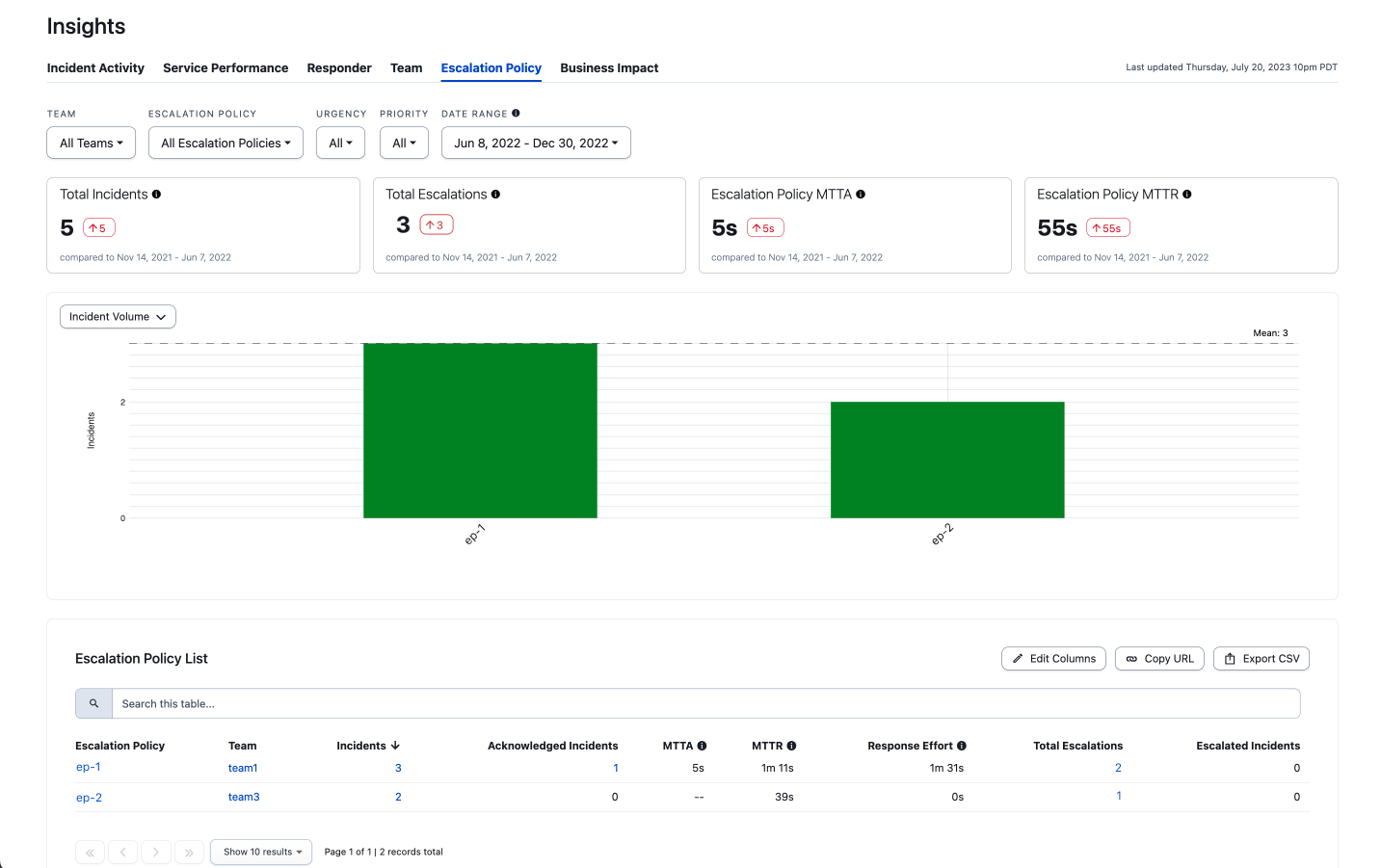
Escalation Policy report
Filter and Search Escalation Policy
Filter Options and LimitsPlease see our Filter Reports section for more information on filtering options.
Each report has the following filter limits:
- Service, Responder, and Escalation Policy Filters: 1000
- Team Filter: 200
Please see our Filter Limits section for more information.
Summary Metric Cards
Each card includes a comparison time period. For example, if you select the time period Last 7 Days, the cards show you the change in each metric compared to the week prior.
| Metric | Description |
|---|---|
| Total Incidents | Total count of incidents matching the provided filters. |
| Total Escalations | Total number of escalations on all incidents. |
| Escalation Policy MTTA | Mean Time to Acknowledge across escalation policies — the average amount of time from when an incident is created until the time the first responder acknowledges an incident. Excludes incidents that were not acknowledged. |
| Escalation Policy MTTR | Mean time to resolve across escalation policies — the average amount of time from when an incident was created until it was resolved. Excludes incidents that have not been resolved. |
Data Visualizations
You can change the dropdown at the top left to select one of following visualizations:
| Visualization | Description |
|---|---|
| Incident Volume | Number of incidents per escalation policy. |
| Escalation Volume | Number of escalations per escalation policy. |
| MTTA | Mean time to acknowledge in seconds per escalation policy. |
| MTTR | Mean time to resolve in hours per escalation policy. |
Escalation Policy List
Below the data visualization you see the Escalation Policy List data specific to the filters you have selected. You may perform the following actions with this table:
- Search: Use the search field to search for specific data.
- Sort: Click on a column header to sort results. You can also sort with multiple columns by holding down the shift key while clicking on both of the columns. The graph above does not change if you sort the data.
- Drill Down: Click an Escalation Policy, incident count, or acknowledged count in the Escalation Policy, Incidents, or Acknowledged columns to view more information about each.
To customize the columns you would like to view, click the Columns icon and select your preferred data. The available Escalation Policy List columns are:
| Column Name | Description |
|---|---|
| Escalation Policy | The escalation policy name. |
| Team | The Team name. |
| Incidents | The total count of incidents that the Escalation Policy experienced with the specified time period. |
| Acknowledged Incidents | The total count of assigned incidents acknowledged by the Team. Only explicit incident acknowledgment counts; reassign, resolve, and escalation actions do not imply acknowledgement. Acknowledgements by added responders are excluded from this metric. |
| MTTA | The average time for the first assigned user to acknowledge an incident. Reassign, resolve, and escalation actions do not imply acknowledgement. |
| MTTR | The average time from when an incident was created until it was resolved. |
| Response Effort | The total engaged time across all responders, measured from the time a responder acknowledges or accepts a responder request until the incident is resolved. Response Effort of resolved incidents can be edited on an incident's details page. Edited values are marked with an asterisk (*). |
| Total Escalations | The total amount of escalations that occurred for the incidents on this escalation policy. |
| Escalated Incidents | The total number of incidents that were escalated. |
| Escalation Policy ID | The escalation policy ID (e.g., PXXXXXX). |
| Auto Resolved Incidents | Total count of incidents that resolved automatically (i.e., not by a human). |
| MTTE | The average time for assigned second, third, and nth responders to acknowledge an incident. It is similar to MTTA, but used only for subsequent escalations after the first assigned user does not respond. |
| MTTM | The time between start of an incident, and the last additional responder to acknowledge. |
| Average Engaged Responders | The average number of responders who engaged with incidents on this escalation policy. |
| Total Engaged Responders | The total number of responders who engaged with incidents on the escalation policy. |
| Timeout Escalated Incidents | Total count of incidents that had timeout escalations that occurred on this escalation policy. |
| Manually Escalated Incidents | Total count of incidents that had manual escalations on this escalation policy. |
| Reassigned Incidents | The total count of a user's assigned incidents that were manually reassigned to a user who is not on the original escalation policy, or to another escalation policy. |
| Interruptions | Interruptions are when an on-call responder receives a mobile push, phone call, or SMS (text) notification. Notifications sent from various channels (push, phone, SMS) to the same destination are counted as one interruption. Notifications that arrive within 60 seconds of each other are counted as a single interruption. Email notifications are excluded from this metric. |
| Business Hour Interruptions | Interruptions that happened on weekdays between 8 a.m. and 6 p.m.* |
| Off Hour Interruptions | Interruptions that happened on weekdays between 6 p.m. and 10 p.m., or on a weekend between 8 a.m. and 10 p.m.* |
| Sleep Hour Interruptions | Interruptions that happened any day of the week between 9 p.m. and 8 a.m.* |
| Total Snoozed Seconds | Total seconds the incident was snoozed. |
* Times are given in the user's configured timezone. If they have not configured a time zone, the report uses the account's time zone.
By default, the Escalation Policy List displays 10 results at a time. Use the dropdown below the table to select from 10, 20, 30, 40, or 50 results per page. If there are more results than the selected dropdown value, you can use the arrows (i.e., , , , ) to navigate through results.
Share the Escalation Policy Report
Read Share a Report for more information on sharing or exporting the report.
Updated 4 months ago